Remaining Useful Life modeling is the practical goal that most rotating equipment condition monitoring programs are ultimately aiming for: not just "this machine is showing anomalous behavior" but "this machine, based on its current degradation trajectory, needs attention within approximately X days or hours." The difference between these two outputs is the difference between an alert that a reliability engineer has to investigate from scratch and an alert that comes with a recommended maintenance window already encoded in its priority level. Three approaches dominate RUL estimation for rotating equipment in industrial applications: LSTM neural networks, Cox proportional hazards regression, and parametric Weibull survival models. Each has different data requirements, different uncertainty characteristics, and different behaviors in the cold-start scenario that's ubiquitous in early deployments. Choosing the right approach — or the right combination — requires understanding those differences with precision.
Weibull Survival Models: Where the Data Is Scarce
Weibull analysis is the oldest and most widely used approach to RUL estimation for industrial equipment. The two-parameter Weibull distribution describes the probability that a machine survives to time t as a function of a shape parameter β (which characterizes the failure rate behavior — β < 1 indicates infant mortality, β = 1 is constant failure rate, β > 1 is wear-out) and a scale parameter η (the characteristic life, the time at which 63.2% of units have failed). Three-parameter Weibull adds a location parameter γ representing a failure-free period.
For a fleet of 12 centrifugal compressors at a gas processing facility — 8 machines with run-to-corrective-maintenance histories over 4 years of records and 4 machines still running (right-censored observations) — a Weibull model fit to the maintenance records produces a population-level failure distribution. β values for midstream centrifugal compressors in the literature typically fall in the range of 1.5–2.5, indicating wear-out failure mode dominance at the fleet level. This makes physical sense: failures driven by bearing fatigue, seal wear, and corrosion all increase in probability over time as the components age.
The strength of Weibull is exactly this: it works with the right-censored data that is the norm in operational fleets (most machines are still running when you observe them), it produces interpretable uncertainty bounds (confidence intervals on the survival curve), and it requires no machine-learning infrastructure. The limitation is that a fleet-level Weibull model gives you a population-average failure probability, not a prediction specific to the current health state of an individual machine. A machine that has been flagged as showing bearing defect frequency growth in its vibration data has a different RUL than a healthy fleet-average machine at the same operating hours — but the Weibull model cannot incorporate that real-time health state information without modification.
Cox Proportional Hazards: Weibull's Covariate-Aware Extension
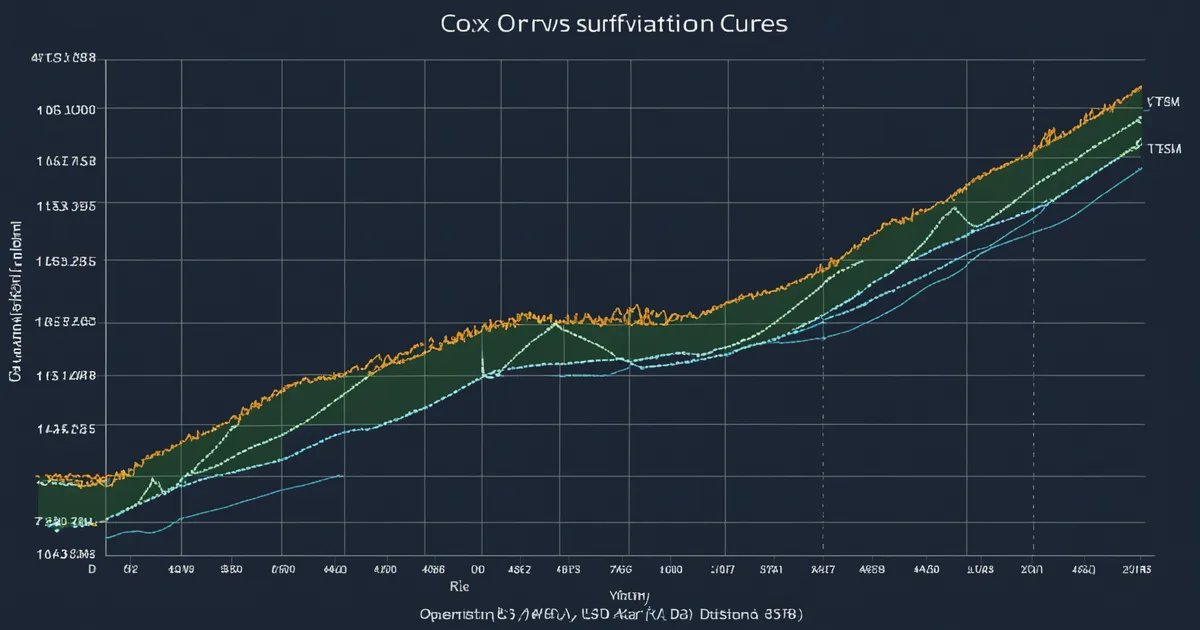
Cox proportional hazards regression extends the survival analysis framework to include time-varying covariates — the measured condition indicators that change as the machine degrades. The Cox model expresses the hazard rate (instantaneous failure rate) as a product of a baseline hazard function (analogous to the Weibull baseline) and an exponential function of covariate effects. In rotating equipment applications, the covariates are the features extracted from vibration and process data: vibration RMS, kurtosis trend, bearing temperature deviation from baseline, and so on.
A Cox model trained on the same 12-compressor fleet from the example above, using time-to-maintenance as the survival outcome and vibration features as covariates, will produce hazard ratio estimates for each feature. A hazard ratio of 3.2 for "kurtosis above 4× baseline" means that machines with kurtosis exceeding that threshold have a 3.2× higher failure rate at any given time than machines with normal kurtosis, after controlling for operating hours. This covariate-driven hazard estimate is the basis for a dynamic RUL probability curve that updates as the machine's condition changes.
Cox models have good behavior on small to moderate datasets (50–200 failure events across a fleet is sufficient for stable estimation), make no distributional assumption about the baseline hazard (the semi-parametric form), and produce survival curve uncertainty bounds that are interpretable in probability terms. The practical limitation for rotating equipment is that the proportional hazards assumption — that covariate effects on hazard are constant over time — may not hold for all failure modes. A bearing in late-stage degradation (last 20% of life) may show accelerating hazard growth that a proportional effects model underestimates.
LSTM Neural Networks: Where Time-Series Pattern Recognition Matters
Long Short-Term Memory networks are a class of recurrent neural network architecture specifically designed to learn temporal dependencies in sequential data. In the RUL prediction context, an LSTM takes as input a time-series window of condition features (vibration trends, process variables, operating conditions over the past N time steps) and outputs either a scalar RUL estimate or a probability distribution over RUL. The LSTM learns, from training examples, what patterns in the feature time series correspond to different distances from failure.
The CMAPSS dataset (Commercial Modular Aero-Propulsion System Simulation, a NASA benchmark dataset for turbofan engine RUL modeling) is the most commonly cited validation benchmark for LSTM-based RUL models, with reported mean absolute percentage error (MAPE) in the range of 10–20% for well-tuned models on the benchmark dataset. Translating that benchmark performance to actual midstream rotating equipment RUL prediction requires substantial caution: CMAPSS is a run-to-failure simulation with clean labels; real operational data is censored, noisy, and has far fewer labeled failure events.
The honest data requirement for a useful LSTM RUL model is 30–50 labeled run-to-failure sequences with at least 100 time steps per sequence (the LSTM needs enough temporal context to learn degradation patterns, not just instantaneous states). For a compressor fleet of 12 machines with MTBF of 24 months, accumulating 30 failure events requires approximately 5–6 years of monitoring data — before the LSTM has statistically sufficient training data. In the interim, the LSTM model will underperform a Weibull or Cox model on the same data because it is data-starved.
Cold-Start Behavior: The Most Important Practical Difference
The cold-start problem — what happens when a model encounters a machine for which it has little or no history — separates the three approaches most sharply. A Weibull model trained on a fleet population immediately assigns a population-average survival curve to a new machine, regardless of whether that machine's design or service conditions are typical of the training population. This is wrong but bounded: the uncertainty is the width of the confidence interval on the fleet survival curve, which is quantifiable.
A Cox model with process covariates does somewhat better for cold-start: as soon as the new machine has a few weeks of condition data, the covariates start adjusting its hazard estimate away from the baseline toward its actual current health state. The model is still anchored to the fleet baseline hazard, but it adjusts faster than a Weibull model does as covariate data accumulates.
An LSTM model at cold start is in the worst position: it has learned temporal patterns from training data, and those patterns require a time-series window of historical context to recognize. A new machine with only 2 weeks of data has a 14-data-point sequence; if the LSTM was trained on 90-day windows, it literally doesn't have enough temporal context to make useful predictions. LSTM cold-start behavior often defaults to a conservative "high RUL" estimate (the model doesn't see any degradation pattern in the short window it has), which means it provides no actionable early warning precisely in the period when an operator most needs it — after installing a new machine or replacing a failed one.
We are not saying LSTM is the wrong choice for mature fleets with abundant failure history. We are saying that LSTM's cold-start weakness and data hunger make it a poor choice as the sole RUL modeling approach for new deployments, new machines, or small fleets. A layered strategy — Weibull for population baseline, Cox for condition-adjusted hazard, LSTM for pattern recognition on the highest-value assets with sufficient training data — holds up better across the fleet lifecycle than any single approach.
Uncertainty Quantification: An Underrated Dimension
A RUL estimate without uncertainty bounds is an overconfident output. A reliability engineer who receives "bearing RUL: 22 days" needs to know whether that means 22 ± 3 days (useful for scheduling) or 22 ± 15 days (not useful for scheduling — the failure could happen in a week or five weeks). Weibull and Cox models produce confidence intervals on their survival curves from the estimation process — these are directly interpretable as probability bounds. An LSTM model's uncertainty quantification requires additional techniques (Monte Carlo dropout, ensemble methods, conformal prediction) that must be explicitly implemented; without them, an LSTM produces a point estimate with no uncertainty information, which looks more authoritative than it actually is.
In operational practice, the uncertainty bound on an RUL estimate is as important as the estimate itself for maintenance planning. A prediction of "90% probability of failure within 30 days" motivates immediate scheduling; "50% probability within 14 days, 90% within 45 days" suggests a different urgency and a different maintenance window target. Condition monitoring systems that report only point estimates are forcing the reliability engineer to make implicit assumptions about uncertainty that should be explicit.
Midstreamly's RUL layer uses a layered modeling approach combining Weibull baselines with condition-adjusted hazard scoring. Ask our team about modeling architecture for your equipment fleet.