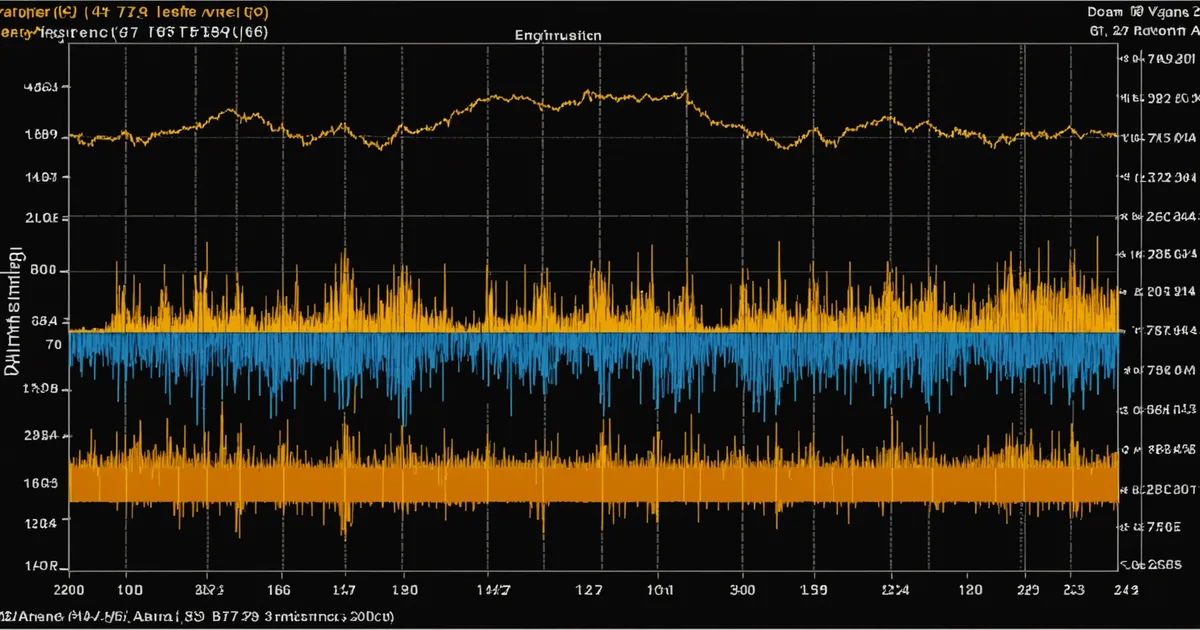
A vibration waveform carries two fundamentally different categories of information depending on how you look at it. In the time domain, you see amplitude versus time — the raw signal that tells you whether something has changed, how energetic the vibration is overall, and whether the waveform shape is periodic, random, or impulsive. In the frequency domain, after applying a Fast Fourier Transform, you see amplitude versus frequency — the spectral decomposition that tells you where in the frequency spectrum energy is concentrated and what mechanical source each component likely corresponds to. Neither domain is superior to the other. They answer different diagnostic questions, and a condition monitoring approach that uses only one of them will have systematic blind spots.
Time-Domain Metrics: What They Catch Early
The primary time-domain statistical descriptors used in rotating equipment condition monitoring are RMS, peak, crest factor, and kurtosis. Each responds to different stages of bearing and component degradation:
- RMS (Root Mean Square): Reflects overall vibration energy level. In velocity units (mm/s RMS), RMS is the basis for ISO 20816 zone evaluation. Sensitive to sustained periodic vibration but relatively insensitive to early-stage impulsive faults that are small in amplitude. RMS is good for tracking imbalance, misalignment, and looseness — failure modes that generate broad, sustained energy increases.
- Peak and Peak-to-Peak: Captures the maximum amplitude in a measurement window. More sensitive than RMS to impulsive events but also more susceptible to transient noise spikes. Displacement peak-to-peak in mils is the standard metric for proximity probe (journal bearing) measurements per API 670.
- Crest Factor: The ratio of peak to RMS. A pure sine wave has a crest factor of 1.41. As rolling element bearing surfaces develop early-stage defects that produce impulse events against a relatively low RMS background, crest factor rises — often to 5–10 or higher in early fault development. As bearing damage progresses and the noise floor rises, crest factor may actually decrease again (lower crest factor in late-stage damage, not because the bearing improved, but because the RMS caught up with the peaks). This non-monotonic behavior means crest factor alone is not a reliable severity indicator, but it is an effective early-detection indicator.
- Kurtosis: The fourth statistical moment of the time-series distribution. Normally distributed data has kurtosis of 3.0. Impulsive signals produce higher kurtosis — a bearing with a small developing spall on the outer race will produce periodic impact events that increase kurtosis to 6–15 before RMS increases significantly. ISO 13373 references kurtosis as a diagnostic parameter. Like crest factor, kurtosis tends to decrease as damage becomes severe and the signal character changes from impulsive to broad random noise.
The practical implication is that kurtosis and crest factor are better early-warning indicators than RMS for rolling element bearing faults — they respond earlier in the fault progression timeline. However, they must be trended over time; a single kurtosis value without trend context is not meaningful. A machine that has always run with elevated kurtosis due to its process environment (a mixer with product flow turbulence, for example) has a different baseline than one that has historically run clean.
Frequency-Domain Analysis: FFT and What It Reveals
The Fast Fourier Transform converts a time-domain waveform sample into a frequency spectrum showing amplitude versus frequency. In rotating machinery, the FFT spectrum is a map of mechanical excitation sources. Key spectral features include:
- 1× Running Speed (1X): Imbalance, misalignment in some configurations, shaft bow. The most common spectral peak in rotating machinery. 1× at high amplitude with stable phase angle relative to a keyphasor = mechanical imbalance. 1× with variable phase = loose mounting or bent shaft.
- 2× Running Speed (2X): Misalignment (radial and angular misalignment typically produce 2× peaks alongside 1×), looseness at twice-running frequency, eccentricity. 2× dominant over 1× often points to coupling misalignment in motor-driven equipment.
- Sub-synchronous (below 1×): Oil whirl instability in journal bearings (typically 0.43–0.47× running speed), surge precursor oscillations in centrifugal compressors, rub. Sub-synchronous vibration is always worth investigating — it indicates an instability mechanism rather than a forced response.
- Bearing Defect Frequencies (BPFI, BPFO, FTF, BSF): Geometric functions of bearing dimensions and speed. These appear as peaks in the FFT when bearing surfaces are damaged. Sidebands around BPFI at spacing equal to running speed indicate inner race defects (the defect enters and exits the load zone at running speed frequency, causing amplitude modulation). BPFO without sidebands is more characteristic of outer race defects in the fixed load zone.
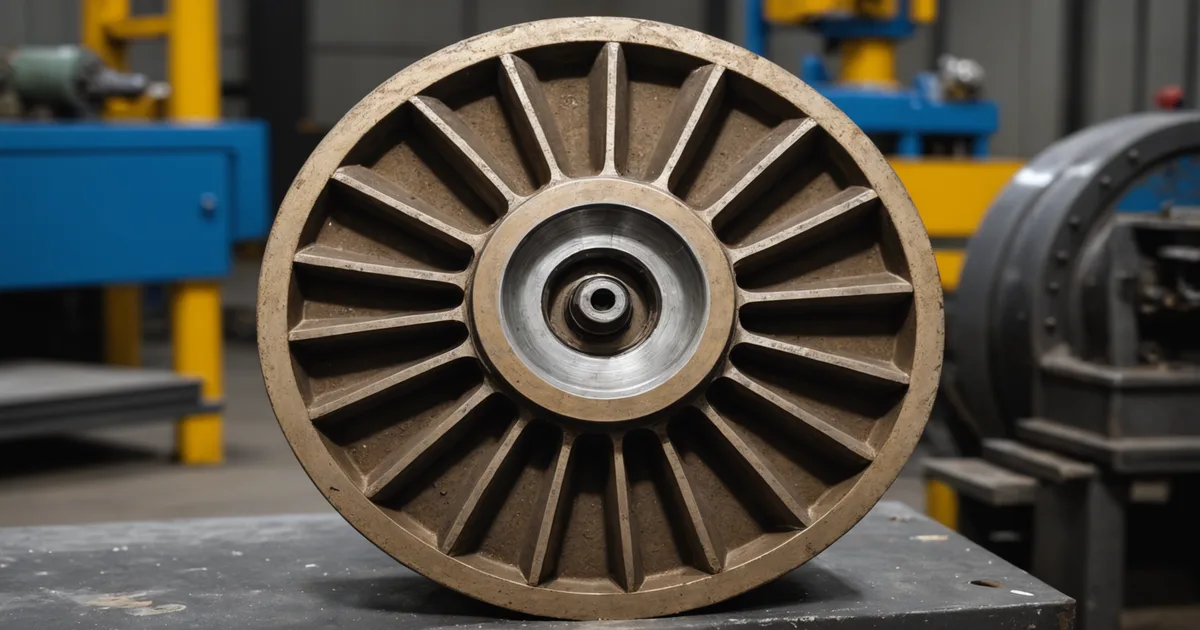
- Vane/Blade Pass Frequency: For centrifugal compressors and pumps, the product of the number of impeller vanes (or diffuser vanes) and running speed. An elevated vane pass frequency indicates impeller damage, partial blockage, or excessive rotor-stator clearance variation.
Order Tracking: When Speed Variation Makes FFT Unreliable
Standard FFT analysis assumes constant speed during the measurement window. On variable-speed equipment — gas engine-driven reciprocating compressors with speed variations of ±2–5%, gas turbine-driven centrifugal compressors under load-following conditions, or any VFD-controlled motor — speed variation smears spectral peaks, widening them and reducing their amplitude. A 1× peak that should appear at a precise 52.7 Hz on a machine running at 3160 RPM may spread across 50–56 Hz if speed varies during the measurement window, making spectral features difficult to resolve.
Order tracking addresses this by resampling the vibration signal synchronously with shaft rotation (using a keyphasor tachometer reference), converting the signal from a function of time to a function of shaft angle, and then computing the spectrum in orders-per-revolution rather than Hz. The result is spectra where 1× always appears at order 1.0 regardless of speed variation, and bearing defect frequencies appear at fixed fractional orders regardless of speed. Order tracking is the standard approach for variable-speed equipment spectral analysis in platforms like Bently Nevada System 1 and Emerson AMS Machinery Manager.
Practical Decision Framework: Which Method to Apply When
For a reliability engineer trying to decide where to invest analytical effort on a specific machine, a reasonable decision framework is:
Use time-domain metrics (kurtosis, crest factor) when: You are doing wide-fleet screening on a large population of similar machines; you want a single indicator that can be automated and trended; the machines are rolling element bearing machines (pumps, small compressors, motors); or you want early-warning alerts that don't require spectrum interpretation expertise.
Use FFT spectrum analysis when: A time-domain alert has been triggered and you need to identify the source; you are performing scheduled route-based data collection on critical machines; you need to distinguish between failure modes (imbalance vs. misalignment vs. bearing defect) that may look similar in overall level; or you are performing acceptance testing on repaired or modified equipment.
Use order tracking when: The machine operates at variable speed; you need to track bearing defect frequencies across a speed range; or you are diagnosing sub-synchronous instabilities where the frequency-to-speed ratio is the diagnostic key.
We are not saying one method is always sufficient — the most capable diagnostic programs use all three. We are saying that trying to apply FFT analysis to all machines in a fleet of hundreds of assets, interpreted manually, is not operationally sustainable for most mid-size midstream operators. The practical answer is to automate time-domain trending for wide-fleet screening and reserve FFT/order analysis for the assets that trigger automated alerts.
Historian Bandwidth Constraints on Frequency-Domain Monitoring
A genuine practical constraint in historian-based monitoring is that the high-frequency acceleration data needed for reliable envelope demodulation and bearing defect frequency detection (10–40 kHz sample rate) is almost never stored in SCADA historians. PI System tags holding vibration data are typically overall RMS values computed in the monitoring instrument, not raw waveform data. This means that histogram-based condition monitoring using historian data will typically only have access to time-domain statistical indicators, not full spectral analysis.
The solution for critical assets — those with sufficient consequence to justify the additional infrastructure — is to complement historian-based overall-level monitoring with periodic or continuous waveform capture using machinery management software (Bently Nevada System 1, Emerson AMS) that can store and analyze high-frequency data natively. The historian-based system handles fleet-wide trending at low computational cost; the waveform capture system handles deep diagnostic analysis on priority assets. The two layers are complementary, not competing, and a condition monitoring architecture that recognizes this boundary will deliver both broad coverage and diagnostic depth.
Midstreamly's anomaly scoring uses both time-domain statistical features and frequency-band energy extraction from available spectral data. Ask our team about signal processing architecture in a technical demo.